Showing posts with label book review. Show all posts

Tuesday, November 28, 2023

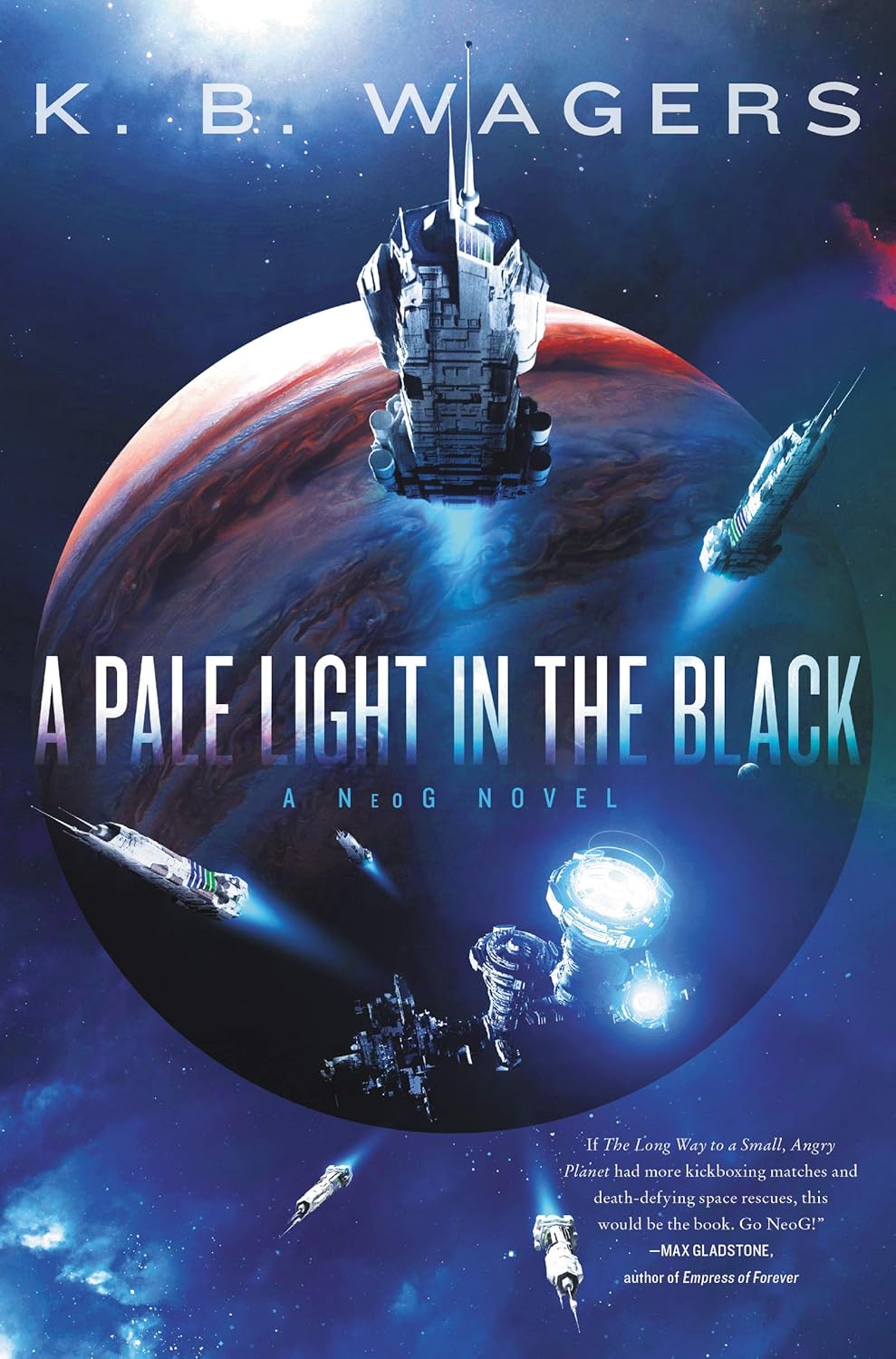
A Pale Light in the Black


A Pale Light in the Black is, unfortunately, not science fiction. It's not even a space opera. It's a sports novel in space.

For the past year, their close loss in the annual Boarding Games has haunted Interceptor Team: Zuma’s Ghost. With this year’s competition looming, they’re looking forward to some payback—until an unexpected personnel change leaves them reeling.

 And Someone is targeting members of Zuma’s Ghost, a mysterious opponent willing to kill to safeguard a secret that could shake society to its core . . . a secret that could lead to their deaths and kill thousands more unless Max and her new team stop them. Rescue those in danger, find the bad guys, win the Games. It’s all in a day’s work at the NeoG.

Based on the description, I expected a story balanced  between preparing for the big competition and uncovering the secret conflict, but that wasn't the case. While there were bits of an investigation scattered throughout the book, at least 80% of the story focused on competition and the celebrity it brought the characters. Maybe 10% of the story was about the characters' family issues and mere 10% about investigating the mystery eventually revealed threat  

I've never liked sports and don't enjoy reading about sports celebrities. So I ended up skimming through the last third of the book.

When the final conflict came, it was a bit of a let down. The villain was too easily caught. There was never any real tension or question about who would prevail.

So, only read this book if you're a sports fan.


Wednesday, July 12, 2023

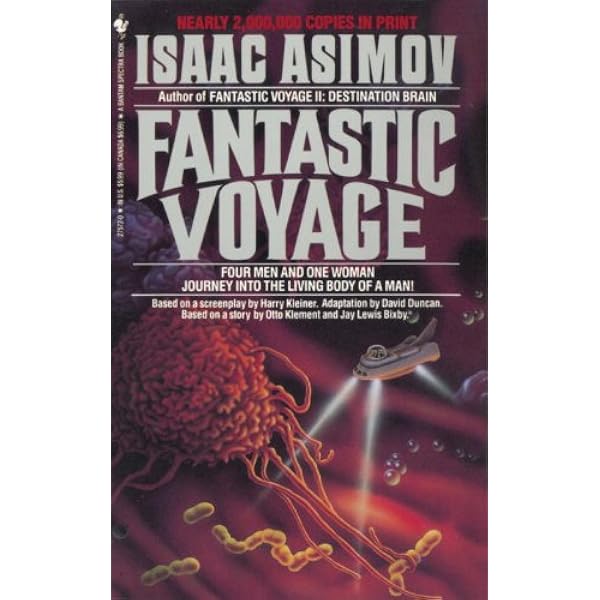
Fantastic Voyage


 Fantastic Voyage by Issac Asimov

Four men and one woman reduced to a microscopic fraction of their original size, boarding a miniaturized atomic sub and being injected into a dying man's carotid artery. Passing through the heart, entering the inner ear where even the slightest sound would destroy them, battling relentlessly into the cranium.

Their objective . . . to reach a blood clot and destroy it with the piercing rays of a laser.


Isaac Asimov wrote the novel based on Harry Kliener's screen play. Rumor has it, that when Asimov saw the original screen play, he remarked that it was full of plot holes and scientific inaccuracies, and insisted on correcting them for the novel. 

Unfortunately, he failed to correct the basic structural and character development flaws. So instead of a 'fantastic voyage', we have a seriously flawed novel. 

The first chapter is literally four "As you know, Bob" conversations about the importance of an off-page character. The Turkey City Lexicon lists an "As you know, Bob" as when two characters tell each other what they already know to bring the reader up to speed. It's a common sci fi trope among beginners. Editors hate it, and this book exemplifies one of the reasons for that hatred. 

By having his characters discuss an off-page character, the author is telling the reader that the characters he's introducing us to on the page aren't that important. So the reader is wondering" if these characters aren't that important, why is the writer wasting my time introducing me to them? Let's get to the real story".

Granted this book was written in 1966, is based on a movie, and opening scenes like this were very common in films of the time. But I still expected better writing from a Grand Master of Science Fiction. 

A second major flaw is the dialog. Most of the dialog consists of one character telling another what they should be thinking. Often with hyperbolic emotional exaggeration that might have worked on the screen, but on the page, makes the characters look like caricatures.

It's was difficult to get into the story, and I was so disgusted with the dialog, I quit reading half way through. Can't recommend this book, not even for historical value.


Tuesday, May 30, 2023

The Glass Teat

I'd heard about Harlan Ellison's The Glass Teat for years, but couldn't find a copy until recently. I'd heard it was an insightful commentary on the deleterious effects television had on the human mind and American culture. Nope, it's not. It's a collection of short vitriolic rants about the lack of realism in a  TV shows and a few other things Ellison didn't like.

According to the book's intro, these rants were originally a weekly newspaper column, reproduced here the order they were written. So there's no real structure, nothing to tie them together.  And since I've never seen most of the shows he mentions, it's impossible to determine how accurate his opinions are. 

The out-of-date references and the vitriolic rhetoric make this book a waste of time for most audiences. The only readers I'd recommend this book for is those specifically studying the counter culture of the 1960s and 70s.

Sunday, May 7, 2023

Chindi

Chindi is the third novel McDevitt's Academy series. But fortunately, you don't have to read the other books to enjoy (or hate) this one Chindi stands on it's own.   

On a routine survey mission studying a neutron star, an Academy starship discovers an alien transmission, but can't track it's origin.
 
Five years later, a satellite finally encounters the signal again, which inspires the Contact Society, a wealthy group of enthusiasts to launch an expedition to track it's origin.  Providing a starship to the Academy to be piloted by Captain Priscilla “Hutch” Hutchins, the Contact Society embarks on a mission to find the source of the transmission.

The novel proceeds like a slow motion scavenger hunt across multiple star systems. And I do mean "slow" McDevitt brilliantly describes the settings, capturing the wonder and awe of alien starscapes. But totally fails with character development.

On page 335 McDevitt explicitly states the recurring theme of the book: 

There have been studies over the years supporting the proposition that groups composed entirely of women usually made intelligent decisions, that exclusively male groups usually did a bit less well, and mixed groups did the most poorly of all.  It appeared that, when women were present, testosterone got the upper hand and men took greater risks. Correspondingly, women in mixed groups tended to revert to roles, becoming more passive and going along with whatever misjudgement the males might perpetrate.

I've seen a few studies on groupthinking and I think this can be true when the women are of lower social rank, new to a group, or subordinate employees. But NOT when the woman is accomplished in her own right, achieves a rank as high as starship captain, or is the only experienced person in a group of amateurs. McDevitt misapplied the theme, and diminishes his heroine, his starship captain, to behaving like teenage schoolgirl desperately trying to fit in with the 'cool kids'. The reader wonders how she ever achieved the rank of captain.

Definitely NOT the way to write a memorable heroine, especially not in the 21st Century.

The other characters are given detailed backstories as they are introduced. (Essentially infodumps) But by the time you're way into the novel half are dead (due to stupid decisions) and rest feel interchangeable. And the frequent POV shifts do nothing to distinguish one from another. 

The conclusion was a major disappointment. The author wrote himself into a corner with the final rescue. And instead of showing how his heroine resolved it, he skipped over it to the point after she had been rescued. And the mystery of the Chindi is left unresolved.

Definitely NOT how I'd write an epic space adventure.


Monday, May 1, 2023

Six Wakes

Six Wakes is a sci fi murder mystery from Mur Lafferty. Five clones (the AI makes six) on a deep space mission wake to find that their previous incarnations have been murdered, they've lost 25 years worth of memories, and the ship's computer has been sabotaged.

Complicating the problem is the fact that all of the crew have criminal pasts. Although their previous incarnations apparently worked peacefully together for over 20 years, these clones don't know each other, and don't trust each other.

Perhaps I watch too much TV. But it seems like the author combined the idea of cloning with the premises of two recent TV shows, School Spirits (where the lead character wakes as a ghost and tries to solve her own murder), and Dark Matter (where six people wake on a space ship with no memory of their past). But the crew of Six Wakes do remember their lives before joining the crew, and flashback chapters reveal that those pasts to be more connected than even their previous incarnations knew.


The Writer's Perspective

Although the story rehashes familiar territory and none of the characters really stand out, Lafferty seems to have a gift for foreshadowing. She weaves hints and clues of what's to come into each character's backstory. I was impressed with how she foreshadowed the characters' prior connections without revealing too much too quickly. This helped the story unfold at a good pace and kept me interested enough to keep reading.


Tuesday, April 25, 2023

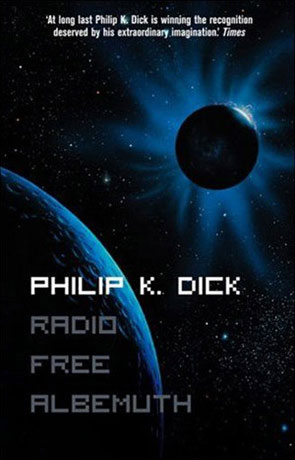
An Essay on Philip K. Dick’s novel, “Radio Free Albemuth”

 In 2004, I was prompted to write an essay to address the following question:  Is America's role in the world contributing to the enhancement of general human welfare?

I had just finished reading  Philip K. Dick’s novel, “Radio Free Albemuth”. So I based my essay on that reading.


I recently read Philip K. Dick’s novel, “Radio Free Albemuth”. In this book, Dick speculated what might happen if the people accidentally elected a paranoid fascist dictator as the President of the United States. Dick died in 1982, and his estate published the book posthumously in 1985. But it’s amazing how closely his vision resembled the events of 2002-2003.


Dick’s fictional villain, Ferris F. Freemont, traveled the country speaking of threats from subversive elements out to destroy the United States. Like Hitler in the 1930s, he used patriotism and fear to rally the people behind his cause. He created the Friends of the American People (FAP). A Nazi-like organization that got people spying on each other in order to ensure their loyalty to the President.
 

Dick’s three protagonists were a novelist, a singer and a record company executive. Since recording artists often have the ability to inspire people’s passions and rally them to a cause, FAP wanted to prevent the singer from recording any music that might criticize the President. They blackmailed the writer into spying on the record executive, and the record executive into spying on the singer.
 

As I read Dick’s novel in March 2003,  I couldn’t help noticing the similarity to the Dixie Chicks controversy. President Bush was traveling the country in 2002 spreading fear about Al Qeada’s and Iraq’s potential for attacking American citizens. Bush said it was essential that we start a war with Iraq. And when a recording artist, Natalie Manes of the Dixie Chicks, criticized Bush’s position, the country jumped on her. 


Political commentators and several major news organizations blasted her. “Support your President,” they insisted. “Doesn’t he deserve your support?” they asked rhetorically. Political commentators harassed her for weeks. Bush’s supporters sent threatening letters, staged protests, and burned her CDs. They pressured her into backing down and apologizing for exercising her right to free speech.
Although Natalie Manes backed down, many other people stood their ground. Janeane Garofalo, Martin Sheen, Mike Farrell, Tim Robbins and nearly 100 other celebrities banded together and continued speaking out against the U.S. starting a war with Iraq. These people weren’t just fighting for peace, they were fighting for their Freedom of Speech. 


The founders of the United States declared that freedom of speech was a basic and inalienable right. Opinions expressed at the time reflected a belief that without the freedom of speech, there could be no true liberty.1 If the ability to pursue liberty is a measure of human welfare, then our welfare has been under a malicious attack by those claiming to cherish it. 


Like Dick’s fictional FAP, the mainstream news media can sometimes act like an oppressive watchdog organization, spewing propaganda under the guise of patriotism and unbiased reports; and doing everything possible to discredit or silence other voices. Dick’s novel shows clearly how losing the freedom of speech can create fear and mistrust among people, and how people ruled by these emotions become afraid to stand up for their rights, or the rights of others. They become afraid to openly question even the most obviously false rhetoric and propaganda.
We must never let these things happen to us.


Natalie Manes showed us that we need to stand up for our Freedom of Speech or it can be taken from us; and with it, our liberty. Tim Robbins and other celebrities show us that we can still stand up and fight for our Freedom of Speech and our liberty. But celebrities cannot do the job for us. We must all maintain the ‘eternal vigilance’ necessary to become aware of these attacks on our freedoms, our liberty and our welfare. 


The United States remains a rhetorical battlefield in which we must continually fight for the right to create a better society. We are all soldiers in this fight. Together we all must stand up for our beliefs and continuously fight to protect our Freedom of Speech.  When Americans fight to protect the Freedom of Speech, we contribute the most to general human welfare. 


It's amazing how good science fiction can remain relevant for so many years in spite of changing culture and technology.
Seven Mercies


Seven Mercies is the second half of the Seven Devils duology. (Read my review of the first book.) Like the first book in the series, it's a mixed bag; a lot to like, and a few things that don't quite work. 

Synopsis

Seven Mercies starts a few months after the conclusion of the first book. The rebel forces are decimated. The empire is stronger than ever, and our heroes are struggling to find supplies. Rumors arrive that the other empire has found a way to free people from the Oracle's mind control. So two of the devils go under cover to verify it. 

In the mean time, the others try to free one of their former leaders from prison before he is turned into a mindless vessel for the AI that runs the empire. It's too late, of course, he's already fully under the AI's control. So when they bring him back, the AI speaks through him, persuading the youngest rebel to return to her job as the AI's programmer and engineer. The AI then persuades her young engineer to write the code that lets it take over everyone in the empire. Everyone with a chip in their head across the entire length of the empire is reduced to mindless drones. (Yep, that's essentially what just happened on Star Trek: Picard Season 3, Episode 9.) 

The rebels must fight through an army of drones to rescue their young engineer and destroy the AI. 

Most of the characters are well developed (although some make really stupid decisions) and action is intense. Making the book enjoyable to read.... if you can ignore the occasional clumsy writing and a basic world building error.

The Writer's Perspective

The first book was marketed as a feminist space opera. But the second book reveals that  four of the characters are bisexual and one is transgender, making this more of a queer space opera. This also creates an internal contradiction that shows the authors failed to do their research. 

In the real world, sexual identity and orientation develop during gestation. The genetic engineering program and artificial gestation process that the authors described would never have allowed the development of homosexual and transgender traits in just a few random individuals among a creche of engineered soldiers. 

This basic flaw in the world building prevents the suspension of disbelief necessary for the reader to totally immerse themselves in the fictional universe. It also highlights how important it is for science fiction writers to research the science they write about.

If you can ignore this basic error, you'll enjoy both Seven Devils and Seven Mercies.


Sunday, April 16, 2023

The Magician's Apprentice

The Magician's Apprentice is a slow moving, poorly constructed prequel to Trudi Canavan's Black Magic Trilogy.

While I enjoyed Thief's Magic and Angel of Storms, I found it difficult to finish this book.

Every chapter has a different viewpoint character (the titular apprentice is only one of a dozen) and several are minor or inconsequential characters. 

Nearly every chapter is dominated by the viewpoint character trying to guess what other characters are thinking. While this shows that all the characters are empathic toward each other, it dilutes their personalities and eventually all the characters just kind of blend together, and you often forget who's viewpoint the chapter is supposed to be in. It also drags the story down, making the reader want to jump ahead to the next action scene. 

About two thirds into the book, the author adds a new subplot, which eventually results in the founding of a new city. I'm guessing this subplot was an origin story to some aspect of the Black Magic Trilogy.  (I haven't read those books) But it was unnecessary for the story in the Magician's Apprentice's, and didn't fit with the primary story.

If you're a fan of the Black Magic Trilogy, you might find The Magician's Apprentice a little interesting. But otherwise, don't waste your time.

Tuesday, April 4, 2023

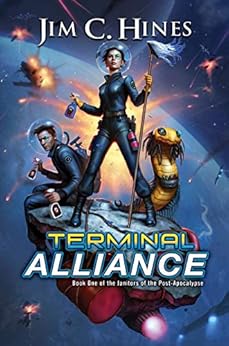
The Janitors of the Post-Apocalypse


The Janitors of the Post-Apocalypse is a comic space opera from Hugo Award winning author Jim Hines.

Book 1: Terminal Alliance

Book 2: Terminal Uprising

Book 3: Terminal Peace

Summary

After a mysterious plague devolves the entire human race into feral monsters, the alien Krakau come to earth and develop a partial cure. The 'cured' humans are recruited as soldiers in their war against the Prodryan. And those who are unfit to be soldiers become janitors on the K's space ships. 

Mops is the lead janitor on the Pufferfish, fortunately for her. While Mops and her crew are in hazmat suits cleaning up the plumbing mess in the alien sector of the ship, the rest of the human crew reverts to their feral state, basically acting like mindless zombies eating the non-human crew and trying to eat anything else they can. 

Mops and her janitorial team are spared this fate, that means the janitors must find out what happened and try to save the rest of the crew. Their investigation sends them across the galaxy chasing clues. Along the way, they discover that most of what they've been told about Earth's history might be a lie. 

Humans might not be as monstrous as they've been told. And the aliens who claimed to save them from the plague, may have been responsible for it.

The Writer's Perspective

Two things I really love about the first book:

  • Nothing is easy for the crew.
  • Even after the janitorial crew take over the ship, they continue to think like janitors.

The janitorial team has to step outside their comfort zone. They have to learn to fly the ship, navigate the galaxy, fire the weapons, infiltrate a space station, steal classified data, treat a plague, and avert a war. Nothing is easy. It takes days/weeks. And it results in a multitude of comic errors. 

But while learning and growing all the characters stay true to their origins. They continue to think like janitors, and find solutions to their problems in their janitorial experience.

Satire can get away with many things that serious space operas should never even try, including toilet humor, aliens that act like humans, and zombies on space ships. (I've stopped reading several books after the first few chapters because the aliens acted like humans.) But Hines combines these elements wonderfully. 

All three books are wonderfully written and lots of fun to read.

Sunday, March 12, 2023

Seven Devils

Seven Devils is the story of five women fighting for freedom against an oppressive intergalactic empire. Eris, the former heir to the throne, threw away her heritage after being forced to kill most of her brothers to earn it. Clo, a mechanical genius from the slums. Nyx an elite soldier who grew tired of killing. Rhea, a genetically engineered concubine. And Ariadne, a genetically engineered computer genius. 

Together they fight against an oppressive empire and the Artificial Intelligence system that controls the minds of nearly everyone in that empire. 

Most novels with more than two POV characters change POVs too often. This makes the characters feel like 'paper dolls', or plot devices to advance the action. The frequent POV shifts prevents me from connecting with the characters or caring what happens to them.

Seven Devils solves this problem by introducing the characters more gradually. We get several chapters to know Eris and Clo before we're introduced to the other three. More importantly, the early chapters illuminate the history of these two, giving considerable depth to the conflict between them.

The book frequently shifts back to the past to describe the traumatic events that led each of the five main characters to breaking away from their former lives. Each of these flashback chapters adds more depth to the characters and helps explain their attitudes and actions in the novel's present. 

 The Writer's Perspective

A couple of weeks ago, I was discussing supporting characters with a fellow writer in the workshop. One of her supporting characters had acted inconsistently from chapter to chapter. In early chapters, she was hostile to the main character. Yet later, she said she'd always been a supporter of the main character's family. This continuity error resulted from the author not developing the supporting character's background early enough to see the story through their eyes. 

Although most novels would not benefit from the back-and-forth structure of Seven Devils, I think authors need to develop their supporting characters' histories, perspective and motivations early in the writing process, or at least when the character is first introduced. Not only does this give the character depth, it also helps inform how the story progresses. And Seven Devils illustrates one of the ways to do that. 

Seven Devils isn't perfect. Because of the frequent viewpoint changes, the writers frequently remind the reader whose viewpoint their reading. They do this by starting or ending sentences statements like "Eris knew..." And this often feels clumsy or heavy-handed. Also, many parts of the novel (especially the space ships and the weapons) would have benefited from clearer descriptions. But the main characters do engage you, especially Eris and Clo. You want to see them overcome their past and resolve their differences. That makes the novel worth reading, and I'm looking forward to the second book of the series


Saturday, February 25, 2023

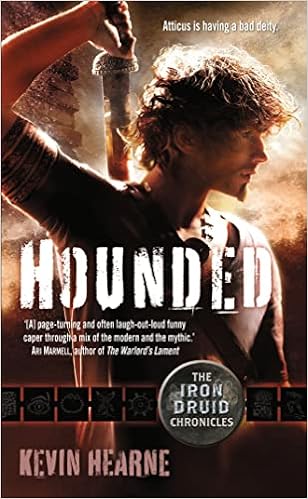
Hounded by Kevin Hearne


Hounded by Kevin Hearne, the first book in The Iron Druid series, is an urban fantasy in the same vein as The Dresden Files and the Alex Verus series. 

Atticus O'Sullivan is a two thousand year old druid living in contemporary Arizona. Some time in the distant past, Atticus absconded with a magical sword that belonged to the Celtic god, Aenghus Og. And he's been either running or hiding ever since.

Things start to heat up when two goddesses separately bring warnings that Aenghus has found him and will soon come to kill him. He's then attacked several times until he's forced to stand and fight.

Like Harry Dresden, Atticus O'Sullivan has lots of magical allies and lots of enemies, including werewolves, witches and vampires.  But unlike Dresden, O'Sullivan has two thousand years of magical experience. He knows himself,  his powers, and the people around him. And he has no trouble seeing through most of the enemy's deceptions. Atticus is smart, personable, and resourceful. Exactly the kind of character I enjoy reading about.

Story wise, Hounded doesn't break any new ground. But it's solidly written and entertaining. The one thing that makes Hounded stand out from other urban fantasies is the canine humor. Atticus has a telepathic link with his intelligent Irish wolfhound, who likes to  joke about sausages and French Poodles. Again, nothing new, but entertaining.

Saturday, February 18, 2023

The Forever War

 The Forever War. details William Mandella's experience of being conscripted into a pointless interstellar war. Madella holds a Phd in physics and planned to become a teacher. But being conscripted ended his plans and his ability to determine the direction of his own life. 

The Forever War is a fish-out-of-water story. The millitary moves Mandella from situation to situation, never giving him a chance get comfortable. He's never given a chance to grow, rise to the occasion, or solve a significant problem. He's a cog in a vast military machine that doesn't care if he lives or dies. This is evident in the callus way half the soldiers die in training before ever seeing real combat. 

After being injured in his first engagement, Madella is released to civilian life. But decades have passed back home, and the world has changed. The government has neglected social reforms to support the war. Crime and inflation are rampant, and Mandella feels more alienated from his home than he did from the military that abused him. He feels forced to reenlist, even though he knows the war is a complete waste.

The Forever War is not the type of story I enjoy, but is one that makes you think. (That's probably why it won the Hugo and Nebula for Best Novel.) The book serves as an allegory for the author's experience in the Vietnam War. And from that perspective, you see how the military industrial complex uses the government to profit off of a war that no one can win. Literally at the expense of people's personal freedoms and social deterioration. 

Not only did this book illustrate the author's experience in the Vietnam War, but you can also see parallels in the more recent Iraq and Afghanistan wars. This makes The Forever War just as relevant today as it was 45 years ago.

The writer's perspective

From the writer's perspective, The Forever War is a great example of how to show the fictional world through the eyes and actions of the protagonist. There are a few info dumps in the dialog between characters. But they're presented as part of an orientation lecture that shows the world the characters are in.


First published in 1974,  

Tuesday, January 17, 2023

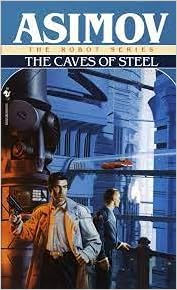
Caves of Steel by Isaac Asimov

Asimov's Caves of Steel is reported to be one of the first cross over science fiction detective stories.

The story takes place thousands of years in the future. But I'd swear I was reading a novelized episode of The Andy Griffith Show. Elijah Baily talks and acts just like Barney Fife. He's prone to wild emotional outbursts and totally irrational accusations. The robot, Daneel Olivaw responds to Baily exactly the way Sheriff Andy Taylor responded to Deputy Fife, with calm rational arguments that do nothing to persuade the irrational detective. The dialog between Baily and his wife was unbelievably ridiculous.

And we were more than 100 pages into the novel before they even started investigating the crime. 200 pages in, and I still haven't seen any empirical evidence pointing to the murderer.

If you're interested in the history of science fiction, you might find this novel interesting. But if you're looking for an entertaining story skip it. 

Monday, May 30, 2011

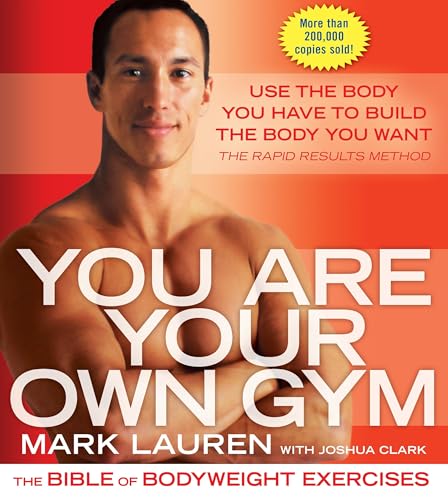
You are your own Gym


I picked up You are Your Own Gym because I have only a 110 barbell set.

The good: lots of different exercises you can do with just your body and stuff around the house, like chairs, towels, phone books, etc.  Lauren shows how to exercise nearly every muscle group, and how to vary the intensity for beginners to more advanced fitness levels. I've only tried a couple of the exercises so far, but they do seem to be challenging.

The bad: Lauren's statements about aerobic exercise and nutrition are totally wrong. Lauren states you don't need aerobic exercise to burn fat, just increase your lean muscle mass. Most people probably need to do both. Lauren also states that you need 2 g of protein for every lb of your target body weight. That's only true for competitive bodybuilders. The average person does fine with 0.8-1.2 g of protein for target body weight.

Using Lauren's exercises may help improve your fitness. But make sure to include some aerobic exercises, and get your nutrition information from a better source.


Update Feb 2023: Recent studies have  shown that walking within the first hour after eating lowers blood sugar, which is essential for burning fat and maintaining a healthy weight. So Lauren's assertion that  you don't need aerobic exercise to burn fat has again been proven wrong.

Sunday, March 6, 2011

Against All Things Ending

Against All Things Ending (The Last Chronicles of Thomas Covenant, Book 3)

Stephen Donaldson's writing as seriously deteriorated over the years. When I read the first series, The Chronicles of Thomas Covenant back in the early 80s, I thought the writer was brilliant. That series was a master piece of world building and character development. Even The Second Chronicles were in many ways brilliant. But in The Last Chronicles, Donaldson trips over his horribly-written female lead.

It's one thing to write a character that has a broken past and is full of self-doubt. It's another thing altogether to bludgeond the reader with constant repetition of those doubts.

Against All Things Ending, like the first two books in The Last Chronicles, is extremely, annoyingly  repetitive. That repetition and the frequent use of obscure words makes this book a chore to read.

Thursday, January 13, 2011

Galaxy Blues and Spindrift by Allen Steele


I few months ago I read Allen Steele's Galaxy Blues. It was my first Allen Steele novel and I enjoyed it. Steele introduced the novel and his main character with a detailed description of a well-thought out his escape from a starship. The narration was light and straight forward, interesting and easy to follow while giving solid depiction of the main character's personality. Not only did I want to read more, I wanted to emulate that narrative style in my own writing. Steele maintained the light narrative style throughout the novel, revealing the characters through their interaction with their environment, which made the book a light, easy read.

Because I enjoyed Galaxy Blues, I was looking forward to reading more of Steele's Coyote series. So when I saw Spindrift on the library shelf, I snatched it up. For most of this book, Steele again does an excellent job of revealing his characters through their actions. However, for the frame character (prolog and epilog), the narration failed to accomplish this.

Spindrift is told in a 'frame' style. The prologue and epilogue relate events 53 years after the main story. From the description on the inside cover, you'd expect Shillinglaw to be a main character, but he only appears in the prologue and epilogue and his chapters seem to be more of an afterthought, filler to make sure the novel meets word-length requirements.

Spindrift is not a particularly thought provoking or challenging novel. There are no plot twists or surprises. There also isn't much world building. (I assume most of it is done in the earlier Coyote novels, which I haven't read.) And some of the characters are a bit one dimensional. But Steele mostly does a good job of developing distinct and engaging view point characters and of revealing characters through their actions.

Since this book chronicles first contact with alien races, it represents a total change in direction for the Coyote series. So if you're a Steele fan, you'll want to read Spindrift first in spite of it's flaws. If you're not a fan, you can skip Spindrift (though I would still recommend Galaxy Blues).

Saturday, November 27, 2010

Parallelities by Alan Dean Foster


Parallelities by Alan Dean Foster

I consider myself to be a casual/occasional fan of Alan Dean Foster. I've read about a dozen of his books and found them all to be moderately enjoyable.

Parallelities is about a sarcastic and imaginative tabloid reporter who suddenly begins traveling through parallel dimensions. The plot is hardly original. Heinlein's Job: A Comedy of Justice used the same plot, as did the Star Trek TNG episode, Parallels. However, where STC was a serious episode, and Heinlein was poking fun at religion, Foster pokes fun at someone else who really deserves it, tabloid reporters.

Foster's character, Max Parker is an arrogant, sarcastic and imaginative writer with no social conscious or professional ethics. He embellishes his stories for entertainment value and has no qualms about it. So it is both poetic and supremely ironic that his life suddenly becomes even more fantastic than the stories he writes. Moving swiftly from one world to the next he never has time to adjust or get his bearings. He meets his counterparts, then aliens and their counterparts. The events/worlds get more and more absurd. And because things are happening to himself, there is no outside verifiable source, he is not allowed to write about what's happening. Ironic, yes?

While reading the book, I thought it went on a little too long. But as I think back on it now, I realize that the length worked for Foster's purpose. Parker isn't just shifting into parallel worlds, he's descending into madness, a personal hell where he can no longer tell what is real and what is fake. It's the perfect punishment for a tabloid reporter, or any reporter who embellishes their reports for entertainment's sake.

If you're a fan of satire, poetic justice, irony, or Alan Dean Foster,Parallelities is worth reading.

Wednesday, June 2, 2010

Heart of the Dragon

I've mentioned before that one of my listeners suggested I read some paranormal romances. So this week, after reading Allan Steele's Galaxy Blues, I picked up Gena Showalter's Heart of the Dragon.

It's a bit of rollercoaster ride switching from sci fi to paranormal romance, but also a bit enlightening. Steel introduces his main characters by their actions. Gena introduces hers by their emotions. Steel describes his character's escape from a space ship with detailed descriptions of the character's actions supported by his thoughts about those actions. Showalter's characters spend the first few chapters fighting unexpected sexual attraction and arousal. Their passion and their reactions to that passion are the main focus of her writing.

As a man, of course, I find it more enjoyable to read about space ships and alien encounters. But I did learn something very interesting from reading Heart of the Dragon. Showalter's characters experience intense sexual desire beyond their understanding or their control; as if their bodies had already decided to mate, and it just took a while for their minds to catch up. The overwhelming intensity of their passion made them feel more alive than anything else in their lives. The whole story reminds me of forced arousal sexual fantasies.

In these fantasies, a lover/seducer arouses your body beyond your control. No matter how hard you try to fight it, your body becomes driven by mind-numbing arousal, and all you can do is lay back and surrender until your body gets what it needs. There are at least two differences: 1) in sexual fantasies one person is deliberately trying to arouse the other, where Showalter has both characters fighting a mutual desire, and 2) in a sexual fantasy, it usually only takes a few pages for the seduced to be overcome, and Showalter's characters require most of a novel. But the primary plot is still about fighting your own body's desire.

When I wrote Demon Seed, I wrote it as a forced arousal fantasy. And I had thought (foolish man that I am) that this genre was completely separate/different than romance stories. But now I understand why my listener said the recording would appeal to readers of romance novels. Although the storytelling styles are somewhat different, the genres do overlap.


Monday, April 26, 2010

Dark Lover by J.R. Ward

I don't normally read paranormal romances, but after a conversation with one of my customers, I thought I should look into it. On her recommendation, I started reading Dark Lover (Black Dagger Brotherhood, Book 1). And I have to say, I was a bit surprised. This is not what I expected from a romance novel.

None of that sappy pining away for the perfect lover. No mushy courting or poetry. Ward's hero makes women feel raw animal lust beyond their control. He turns two women's brains to instant mush just by his presence. In fact, the women's responses in at least two scenes very closely resemble many scenes in the mind control porn at The Mind Control Story Archive.

Naturally, Ward's hero is better developed and much more interesting than any character found in amateur porn. And the provoked lust is just a small component of her stories as a opposed to the focus of mind control porn. But now I understand why my customer said that my hypnotic audio stories would appeal to the same audience as Dark Lover. We both 1) aim to develop sympathetic and identifiable characters, and 2) aim to provoke intense erotic feelings in our characters and our audience.

The backstory for Wrath, the male lead, was also very interesting. This is a strong, but flawed character who doesn't understand his own worth. He is the hereditary king of the vampires, but he has refused to accept the throne because he blames himself for his parents death. After 300 years of living alone, he is surprised to find a woman that can make him feel any emotion beyond self loathing. And it is through the desire to be worthy of that woman that he finally starts to accept that he might be worthy of more himself.

I found the villains of the story to be superficial and a bit forced, but they played a crucial role in Wrath's decision to become more than he previously was.

Overall, Dark Lover is a fairly good book. Enjoyable even for those of us who'd rather read sci fi than romance.